
They’d never measured true cycle time per subprocess before Clarity
The AI Box
The AI Box that
reduces microstoppages.cuts cycle times.trains new hires faster.reduces diagnostic overhead.
Clarity is a physical AI platform that runs parallel to your production system. It adapts to it, captures what's physically happening in real time, and gives you the data to cut microstoppages and waste.
The problem
Microstoppages and diagnostic overhead are costing you millions of dollars per year.
You’re a midsize manufacturer. You know what would make your line run better, but you can’t put your finger on it. And it’s costing you millions of dollars a year in microstoppages and waste.
Option 1
Ask your OEM.
They only show up when something’s already broken.
Option 2
Hire a systems integrator.
Pay $600K for a 6-month engagement, and you still don’t own what they build.
Enter Clarity: a physical piece of equipment you own outright, just like every other critical machine on your floor. Not someone else’s black box.
How it works
Deploy. Connect physical sensors. Eliminate microstoppages.
Step 1
Deploy
Deploy Clarity on your production floor.
Step 2
Connect physical sensors
Plug and play any sensor data sources.
Step 3
Eliminate microstoppages
Clarity flags every handoff, sensor, and process that’s dragging on your line.
Why Clarity
Why Clarity, not a $600K systems integrator?
It operates in the physical world.
Clarity is a parallel system. It can’t write to your production system, by architecture, not promise. What you get is AI vision into what’s physically happening on your line, not a dashboard guessing at it.
Vision, then the tools to act.
Not just a chart: Clarity hands you the tools to actually fix what it finds.
You’re in control. Nobody else.
Stop paying $600K CapEx systems-integration projects for someone else’s black box. With Clarity, you own the build.
Ask & act
Ask a question. Get the subprocess that’s actually slow.
You
Tell me the relationship between Sensor A and Sensor G.
Clarity
Sensor A sits at Fill, Sensor G at Capping, four stations downstream. When Sensor A’s cycle time climbs past 4.0s, Sensor G starves within 90 seconds. That’s your bottleneck, not Capping itself.
Cycle time · Fill → Capping subprocess
Built for
50–500 people
Industries
Discrete, formulation & metals
Deployment
Live in NYC
Founded by
Manufacturers
The product
Software and hardware, shipped as one box. We’re not another dashboard.
Clarity is software and hardware shipped together, not a dashboard bolted onto data you already had. Most “operations AI” stops at your historian. Clarity runs one layer deeper, catching what your systems never log. That’s the layer where microstoppages and waste actually happen.
Results
One real deployment. No hypotheticals.
Custom-formulation manufacturer, New York City · first Clarity deployment
The customer is a growing manufacturer that makes custom beauty products in Brooklyn, NY. They needed a parallel data system that could be iterated on faster than their OEM equipment. We deployed Clarity in two weeks, showing them their baseline cycle times and giving them the data to begin iterating on cycle time reduction.
We connected their existing systems read-only, ran a parallel physical layer on the line itself, and mapped the line end to end, establishing real baseline cycle times for the first time. Everything the team already knew, plus everything the floor was quietly telling us, went into the knowledge base instead of staying in one person’s head. See the physical layer that made it possible →
Cycle-time visibility
First ever
Time to first baseline
2 weeks
Hardware footprint
Nvidia Jetson Edge-Compute
Deployed once, not a fleet
Security & data
Read-only. By architecture, not by promise.
It physically can’t write to your systems.
Clarity is a parallel system. It doesn’t need to interact with your ERP, historian, MES, or any other IT system you run. It physically can’t write to production systems, so it has zero impact on your operations.
One integration to vet, not a fleet to manage.
Where sensors are deployed, they’re purpose-built and isolated to monitoring, not a general-purpose IoT gateway for IT to patch. One integration to vet, with documented scope of exactly what Clarity touches.
Your data stays yours.
Your data stays on-prem, and you have total control. It’s never shared, pooled, or used to serve other customers.
Deployed to fit your environment.
On-prem and air-gapped, fully available for organizations that require full data sovereignty. Cloud-hybrid solutions are possible where that fits your environment better.
Get a free operations audit
A read-only look at your floor: we show you what Clarity surfaces, no commitment.
The team
Built by people who’ve run machines, not just modeled them.
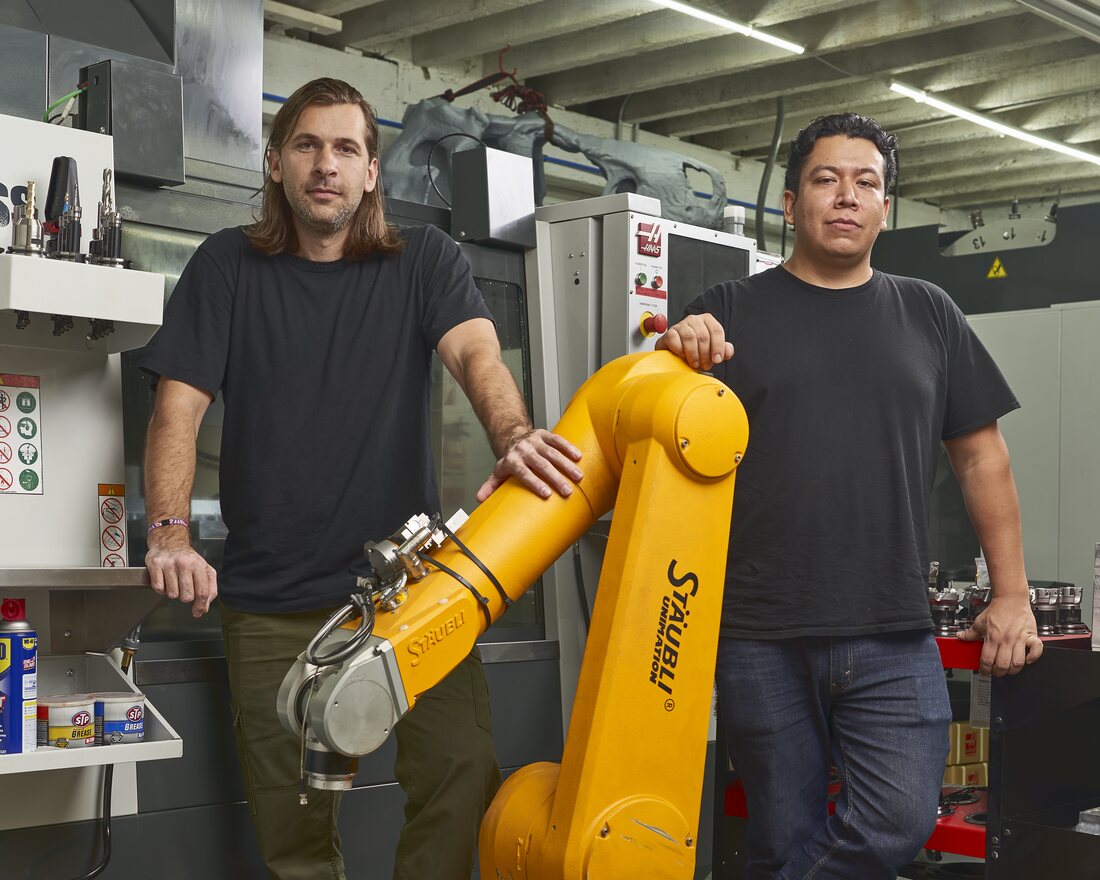
Wil Barnes (left), Oscar Elizalde (right) · Brooklyn, NY
Wil Barnes & Oscar Elizalde · Co-founders
- We’re manufacturers ourselves: subtractive and additive, aluminum and steel, fabrication.
- 10+ years each across software development and manufacturing engineering. We speak both languages, and we’ve sat through the $600K integrator quote on the other side of the table.
- Brooklyn-based. For NY-metro plants, we’re on your floor same-day when it matters.
Sid Powell · Advisor, CEO, Maple Finance
Nick Hebert · Enterprise Sales Director
Questions plant managers actually ask
Clarity is software and hardware, built precisely for each other, working in unison. The hardware is commodity edge-compute. The software is what turns it into a physical AI platform for your operations.
For most manufacturers, the next phase of productivity gains comes from physical process improvements, not another layer of transactional software. Clarity goes one layer deeper into the physical world, where microstoppages and diagnostic overhead consume millions of dollars per year and go unsolved.
A parallel system is one that stands alone. It doesn’t require OEM or integration approval. It doesn’t touch PLC or SCADA systems (unless you want it to). It receives updates in-situ, without affecting the rest of your OT stack.
Just the physical thing or process you want to capture. No ERP/Historian/anything else required. Clarity is a true isolated solution that delivers value without onerous integration CapEx.
No, we deploy without hard stops. Clarity deploys fast.
Typically yes, but we’ve seen success proving efficiency gains with photoeyes before moving to more advanced sensor vision systems. With Clarity you scale as you prove utility.
You do, outright. Every data event belongs to you, stored wherever you want to store it, and it compounds over time. We’re the on-demand software development layer that maximizes your results.
Yes absolutely, we’re the first, easiest step to you digitizing your plant. And you don’t need to make massive CapEx investments right out of the gate.
Diagnostic overhead and executive reporting wins in as little as a week.
The knowledge to keep running is already in your building. It just needs somewhere to live.
Tell us about your operation: we’ll show you what Clarity finds on your floor